
Data infrastructure for the agentic loop
Data systems were built around a human loop. A person writes a query, waits, reads the result and decides what to do next. That loop has shaped almost every design decision in today’s engines, from how jobs are scheduled to how errors are reported.
That loop is changing. More and more jobs are now issued by AI agents, and their results are read by agents too. The most demanding version of this is what we call continuous exploration: AI systems that propose a hypothesis, run an experiment, evaluate it, refine the hypothesis and repeat, thousands of times in parallel, to attack hard problems in science and engineering.
We started an initiative to build open-source data infrastructure for exactly this setting. This post explains why we think it needs new infrastructure, and what we are building.
The exploration loop
An exploration loop is the scientific method, automated. Scientists set the objective and approve the expensive steps. Agents do the rest, round after round:
- Propose. Agents form new hypotheses, often by mining the results of earlier rounds.
- Implement. Agents turn each hypothesis into a change to code or data, for example a candidate training dataset.
- Run. The candidates are trained, simulated or sent to a lab, small runs first, with only the best moving on to larger scales.
- Evaluate. Every candidate is scored against the current baseline, per slice and across seeds, and the results go into a ledger the next round learns from.
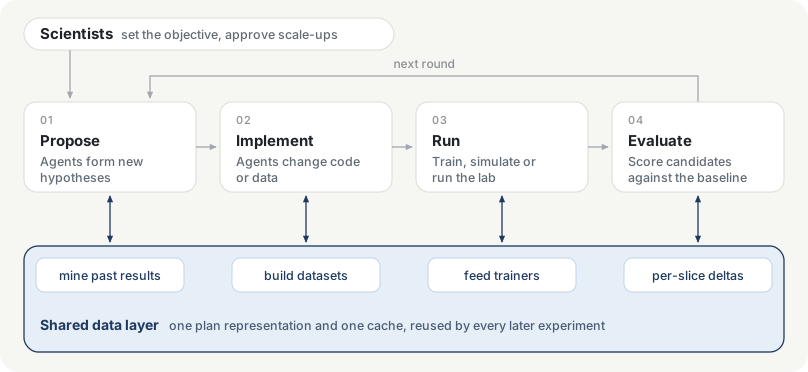
The loop has the same shape whether the experiment is an ML training recipe, a genome-wide analysis or a materials simulation. What changes is the runner and the evaluator. What stays the same is that every step reads or writes large amounts of data.
Why the data layer sets the pace
Once agents propose and implement hypotheses, the speed of the loop is bounded by everything else: preparing inputs, feeding training and judging outcomes. In many domains those steps are dominated by large-scale data processing.
This is especially true in data-centric ML, where many hypotheses are data changes: a new quality filter, a different dedup threshold, a reweighted mixture. If the data layer treats every one of those experiments as an independent full pass over the corpus, the whole loop runs at the speed of the data layer.
What changes when agents are the users
When the client of a data system changes from a person to an agent, almost every assumption behind its design changes with it.
| Human-driven | Agent-driven | |
|---|---|---|
| Who issues jobs | Engineers and analysts | Planner, implementer and analyst agents |
| Job rate | Tens to hundreds per day per team | Thousands to millions per day per loop |
| Job shape | Mostly independent | Mostly small variations of earlier jobs |
| Tolerated latency | Minutes to hours | Every second of waiting is an idle reasoning step |
| Result consumer | Dashboards and notebooks | Models reading compact, structured results |
| Failure handling | A human reads the error | Errors must be actionable by a model |
Five properties of this workload drive our design:
- Massive, redundant concurrency. A proposer fans out hundreds of variants at once, and most differ from each other by one threshold or a few mixture weights. An engine should pay for the differences, not the totals.
- Latency stalls reasoning. Time to first result matters as much as throughput, so fixed overheads and stragglers matter as much as raw bandwidth.
- Long-running loops. A loop runs for days and keeps coming back to the same baselines, scores and embeddings, so results must outlive a single job.
- Mixed CPU and GPU compute. Joins, dedup and aggregation run on CPUs, interleaved with classifiers, embedders and model-based graders on GPUs.
- Two ways to consume data. The same data is analysed in batch and streamed into trainers at accelerator speed.
Today these needs are spread across systems that share neither an optimizer nor a cache: batch engines with little reuse across jobs, warehouses that are awkward for model-in-the-loop transforms, and training dataloaders that live apart from analytics and evaluation.
What we want the data layer to be
We think the right design treats a whole exploration loop as one large, slowly evolving computation, and pays only for what changes between rounds. Concretely:
- One engine for the whole loop. Data preparation, model inference, evaluation and training feeds share one plan representation and one cache, so work done for one experiment is reused by every later one.
- Built for agents. Fast enough to keep up with an agent’s reasoning step, safe under thousands of concurrent and occasionally wrong clients, with results and errors a model can act on.
- At the scale of science. The same loop that tunes an ML data recipe also drives genome-wide analyses, climate scoring, compound screening and particle-physics event selection, on CPUs, GPUs and RDMA fabrics, elastic on preemptible capacity.
- Open and portable. Apache 2.0, built on open engines (Velox and Axiom), and deployable on any Kubernetes cluster.
The first building blocks
We have built the first three pieces of this layer, all open source:
- Ember is a distributed C++ DataFrame engine on Velox and Axiom. Every stage of a job gets a content hash, so a stage that an earlier job already computed is reused instead of recomputed, and calls to language models are ordinary DataFrame expressions.
- Kiln is a tiered store for ephemeral data: shuffle data, cached results and training-feed chunks. Chunks are immutable and content-addressed, so two agents that produce the same result share one copy, and clients read and write them with one-sided RDMA.
- Stoke is a distributed PyTorch dataloader. Preprocessing runs as an Ember job, and Stoke streams its output to trainers through Kiln while the job is still running.
An agent submits DataFrame jobs to Ember. Every intermediate result that should outlive a task lives in Kiln, so it survives worker loss and later jobs can reuse it. Stoke turns Ember’s output into training batches.
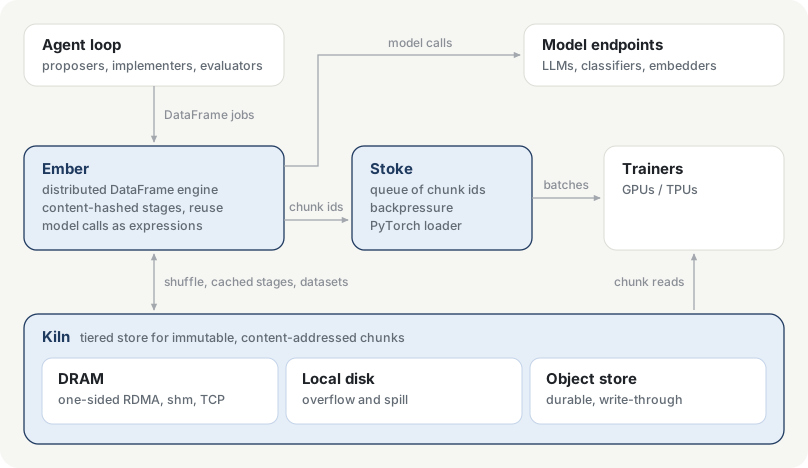
These are early systems, tested so far on a single host. Next we are taking them to clusters with GPUs and real RDMA networks.
What’s next
In the next post we will introduce Ember in more detail: how it reuses work across near-identical jobs, how it runs model calls inside a query, and how it compares with established engines. If you are building agentic or scientific workflows and want to try any of this, the code is on GitHub, and we would love to hear from you.